Once again(!) 4 die falling off overcrowded local trains
Mumbai’s anti-poor “world-class” infrastructure is to blame!
The reality of Mumbai’s so-called “world-class” transport infrastructure: Bullet trains, Vande Bharat and AC locals are being run for the rich; working people are forced to risk their lives commuting by hanging on footboards of buses and trains!
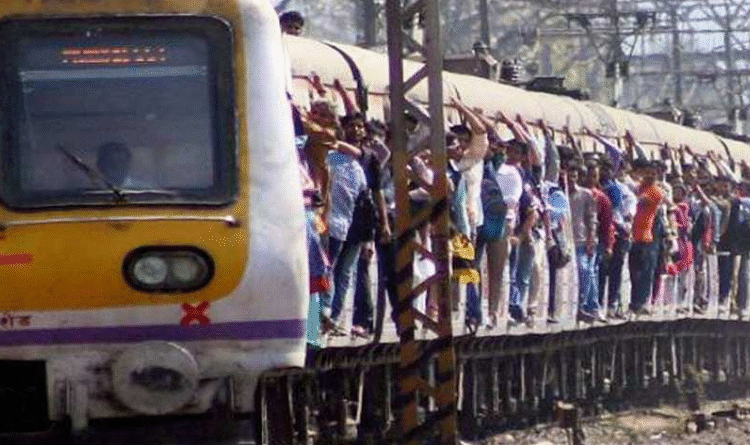
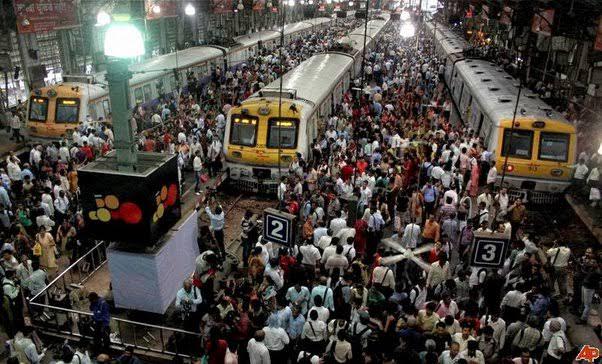 51,802 people (equivalent to the population of a small town) have died in the past 20 years in railway accidents in Mumbai. In other words, 7 people every day. What is more grotesque? This statistic, or the fact that it has been normalized and that Mumbaikars are forced to accept this as a fact of life! The latest incident which has forced this fact to resurface is the death of four individuals after falling off a moving train near Mumbra railway station in Thane on Monday 9th June 2025. Passengers hanging off one train’s footboard reportedly got entangled with similar passengers of another train when the two passed while travelling in opposite directions along a sharp curve. A total of eight passengers supposedly fell, out of which four succumbed to injuries. As the ritual demands, a compensation of Rs 5 Lakh has been announced for each of the deceased and each injured victim will receive compensation between 50,000 and 2 lakh. An “investigation” has been launched to determine the “exact cause” of the incident, which will either be inconclusive or find some way to blame the locomotive driver, or some other workers, or the passengers themselves. The real structural factors, have to do with the ruling class’s pro-rich, anti-poor “vision” of development and transportation in Mumbai:
1. The uneven development forcing massive over-crowding in metropolis like Mumbai, is essentially a result of the growth model working for profits of the capitalist class, who benefit from the over-crowding in metro cities leading to intensified labour competition, separation of working spaces from residential areas as land gets further commercialised with control of builder lobbies and creating pressure for transportation systems. The real solution remains to de-crowd cities, and it is possible only by fighting the hold of the builder, contractor, transporter lobbies, and the capitalist class on the state machinery. However, even many short term immediate transportation solutions remain unimplemented due to the same pro-rich, anti-poor bias!
2. There is a severe lack of train services on the Thane – Dombivali stretch. There were at least 26 incidents in the same stretch last year. Trains run late during peak hours and many ordinary locals have now been replaced with AC locals, whose ticket prices are unaffordable for the majority of citizens. The AC locals further reduce the scope for expansion of normal local services. There are in fact many such “fatal stretches” along Mumbai’s train routes which only come to light when such ghastly incidents happen.
3. As a result, local passengers are forced to travel into already crowded passenger trains, such as the Pushpak express onto which the passengers on June 9th had boarded. The number of passenger trains, again, is ridiculously inadequate. The railway minister is busy constructing a completely unnecessary bullet train route and commissioning more Vande Bharat trains which travel half-empty. The objective is not to provide essential services to the working class but to promote comfort and luxury for the miniscule rich!
4. BEST, TMT bus transport infrastructure has been dismantled. BEST runs 2,594 buses for a population of close to 1.5 crore. This is equivalent to 12 buses for a population of 1 lakh. (Typically, a ratio of 150 buses to 1 lakh population is considered to be “good”). All (or almost all) long BEST routes have been discontinued and BEST has been converted into a feeder service for metro stations. And ticket prices for metros are three to four times higher as compared to local train tickets for similar distances. BEST fares too were doubled in April, leading to a steep 10% drop in ridership.
5. The decline in BEST services started with the slow and steady measures taken for its privatization post-2005 and the deterioration has been more drastic since 2019, when the BJP and Shiv-Sena backed unions signed an agreement to not oppose any “economy and efficiency measures” (read “privatization”) taken by the administration in exchange for a ’10 step wage increment’ to reduce the pay disparity between junior employees and other ‘regular’ BEST employees. The leader of the biggest BEST union, who had opposed this agreement then, joined the BJP in May.
6. The privatization of BEST buses (only about 17% of BEST fleet is government-owned, the rest run by private contractors) has meant cutting costs on maintenance of buses and various safety measures. The 1-month training period of BEST drivers was replaced by a 1-day training period. This, combined with the facts that the vehicles are poorly maintained and that the drivers are forced to complete fixed kilometre targets (or face fines otherwise) has resulted in a steep rise in the number of accidents. At least 40 people have died in such fatalities in the past three years alone, with the death on 9th June, wherein a 32-year-old daily-wage labourer, Barkat Chand Sheikh from Rafi Nagar, Govandi came under a BEST bus, being the most recent example.
7. Precious funds, which can be used to upgrade the bus and suburban rail transport infrastructure of the city are being used to construct highways, freeways and expressways for private cars and metro networks for the rich. The highly environmentally destructive coastal road, cost Rs 14,000 crore.
Once again, there is of course, the more basic question of why people are forced to commute such long distances in the first place. This is a consequence of the rule of the capitalist class, led by builder, transporter, contractor lobbies in the city, for whom “beautification” and modernisation of Mumbai has meant moving the poor out of sight to distant lands. Slums in the the south and central regions of Mumbai are demolished and residents are forced to move into decrepit SRA buildings in the northern corners of the city. Real-estate prices are such that almost no one, except the top 0.5% can dream of buying a decent house in the city. As a result, a large section of the working population of Mumbai has no option but to spend a quarter of their waking-day in commute, for the only place they can afford to stay is 30 km away from their workplace.
These, in summary, are the “exact reasons” for the deaths of June 9, and for the ~3000 deaths which take place every year due to rail and bus accidents. What we need is a mass movement demanding good housing near the workplaces for all, and in the short term a movement for adequate, cheap, and accessible public transport for all which will demand the suspension of all coastal roads, all freeways, and expressways until the government abolishes privatization in public transport. This is possible only as a part of a broader movement against privatization, demanding government intervention in ensuring citizens’ fundamental right to transport among other rights.
We, the working people of Mumbai need to raise our united voice now!