Demand accountability from the rail authorities! Demand free and fair transit that is accessible to all!
Public Transport is for people, not profits!
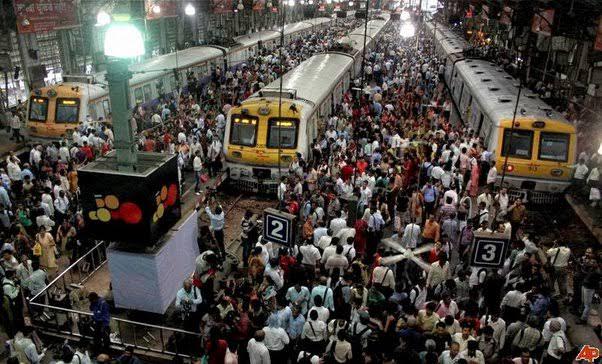
Over the past two decades, 52,300 people have died on Mumbai’s local train network, a staggering statistic that clearly showcases a systemic failure. A bench of the Bombay High Court remarked that passengers are carried like “cattle or even worse,” in response to a recent PIL highlighting the increasing number of passenger deaths.
The court has called for an “urgent action” on the same. However, this is not the first time that it has done so. In 2015, too, the Bombay High Court had issued a stern statement criticizing the railways for the alarming number of deaths nine people every day – due to overcrowding and inadequate safety measures. Nine years later, the fatalities persist. It is evident that the judiciary’s empty statements have done nothing to address the issue. A persistent ignorance of the root cause of this phenomena has ensured the continuation of unacceptably high accidents and deaths.
In affidavits filed as a response to the above PIL, rail authorities continued to defend themselves by claiming a reduction in the number of deaths in the recent years. For the sake of clarity, a total of 29,321 and 16,475 death cases were submitted by the Central and the Western Railways, respectively, from 2009 till June, 2024. It is deplorable that such claims are continued to be made in the face of these statistics.
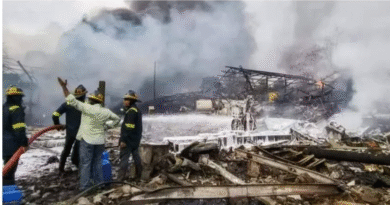
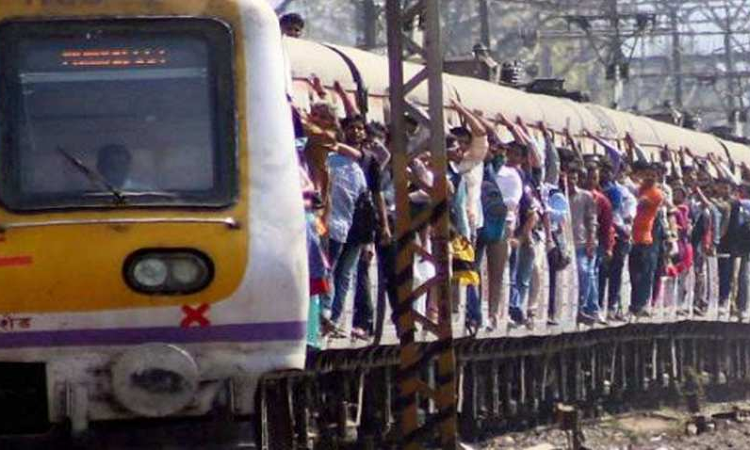 Accidents due to passengers falling off trains are only one of the many problems associated with the railways. Mumbai has faced multiple tragedies linked to its railway infrastructure. More than 20 people were killed in the stampede at the Elphinstone Road railway station in 2017.
The collapse of a section of the old Gokhale bridge at Andheri station that connects Andheri East and West stations and is used by thousands of commuters every day had led to the death of 2 people in 2018.
Bridge collapses, disrupted train services, and casualties brought about by heavy rains continue to occur on a regular basis.
Maharashtra’s budget allocation for railway infrastructure has seen an increase of 13.5% from the previous year. There is a stark contrast between the revenue generated from local trains – over ₹3000 crores in Just three months, as recorded in 2021 and the state of the infrastructure. This showcases a clear disparity in the allocation of funds to the railways and the utilization of the same. Within the Indian Railways, the government’s focus on privatization and profit-driven schemes, such as the Vande Bharat and Amrit Bharat station schemes, highlights the anti-poor character of the state. Projects amounting to thousands of crores are allocated to private contractors, only a part of which is actually utilized for the railway infrastructure. Train tickets are priced unreasonably to increase corporate revenue. Today, private gains and the profits of a few take precedence above the needs of the common masses, while the state continues to deflect responsibility by blaming migration and over-population.
The rise of passenger segregation – evident in the division between First Class, Second Class, and Air-Conditioned trains – perpetuates inequality, offering better services to those who can afford to pay more while leaving the working masses to endure overcrowded and inadequate conditions.
The focus on class-based pricing creates a transport system that caters to the rich while neglecting the needs of the working people. In a city like Mumbai, the local train system is not a convenience – it is a necessity. The profit-centric system of today exploits the masses by leveraging the fact that public transport is a fundamental necessity for them.
The government must be held accountable for the accidents and deaths and ensure detailed transparency in spending. The segregation based on class and pricing should be abolished, ensuring that public transport serves its intended purpose: accessibility and affordability for all. The organized youth and working masses of this country are the only force capable of holding the state accountable and ensuring that public services such as transportation prioritize people’s needs over private gains.
We demand the following:
1. Immediate action must be taken to prevent accidents and fatalities on Mumbai’s local trains, including sufficient infrastructure improvements. Adequate trains must be run to ensure that no more passengers than the sanctioned capacity need to board the train.
2. Abolish class-based fare structures and ensure that public transport remains affordable and accessible to every citizen.
3. The privatization of public transport systems must be put to an end.